What is In This Content?
Deposition is a concept that often sparks curiosity In the vast and fascinating world of science. You might have heard the term in geology or chemistry, or even in physics. But what does it really mean? And how is it different from similar processes like condensation or erosion?
Let’s dive into the scientific meaning of deposition, how it works, and where you’ll find it in nature and everyday life.
Definition: What Is Deposition?
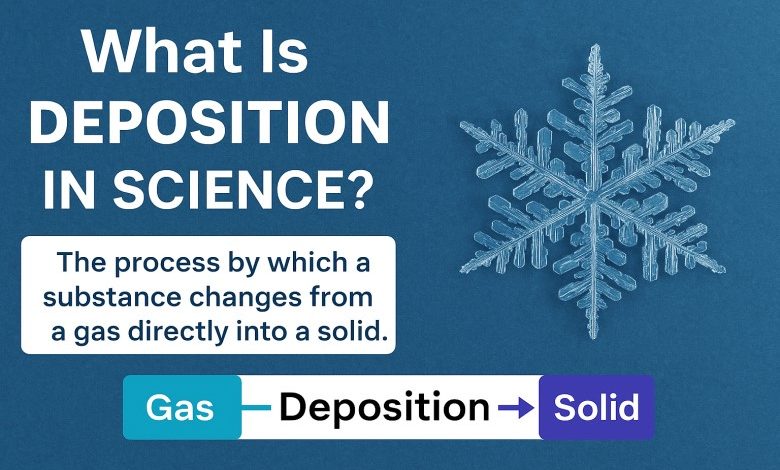
In science, deposition refers to the process by which a substance changes from a gas directly into a solid without passing through the liquid phase. It is the reverse of sublimation, where a solid turns into a gas without becoming a liquid first.
This phase change is a physical process, meaning the substance itself doesn’t change chemically it simply changes its state of matter.
Real-World Examples of Deposition
Understanding deposition becomes easier when you see it in action. Here are some common examples:
| Example | Description |
|---|---|
| Frost formation | Water vapor in the air turns directly into ice crystals on cold surfaces (like grass or car windows). |
| Iodine vapor deposition | Iodine gas cools and forms solid crystals without becoming liquid. Used in web in science labs. |
| Volcanic gas deposition | Volcanic gases like sulfur can cool and form solid sulfur deposits around vents. |
| Formation of snowflakes | Water vapor in clouds changes directly into ice crystals, forming beautiful snowflakes. |
Deposition vs. Other Processes
To better understand deposition, it helps to compare it to other phase changes:
| Process | Phase Change | Example |
|---|---|---|
| Sublimation | Solid → Gas | Dry ice turning into CO₂ gas |
| Deposition | Gas → Solid | Frost forming on a cold morning |
| Condensation | Gas → Liquid | Dew forming on grass |
| Freezing | Liquid → Solid | Water turning into ice |
Where Deposition Happens in Nature and Science
1. Meteorology
Frost and snow are products of deposition in the atmosphere. These processes play a key role in weather and climate.
2. Geology
In sedimentary rock formation, “deposition” refers to the settling of particles carried by wind, water, or ice. Though different from the phase change definition, it’s another important context where the term is used.
3. Industrial and Scientific Applications
- Chemical vapor deposition (CVD) is a technique used to produce thin films and coatings in the semiconductor and solar industries.
- Metal refining processes sometimes involve deposition to extract pure metals from gases.
Why Deposition Matters
Deposition might seem like a small or rare event, but it plays a crucial role in:
- Weather patterns and frost prediction
- Snowflake and ice crystal formation
- Technological applications in electronics and material science
Understanding this process helps us interpret both natural phenomena and engineered technologies.
Final Thoughts
Deposition is one of nature’s elegant shortcuts a transformation that skips the liquid state entirely. Whether you’re marveling at frost on your window or studying advanced semiconductor coatings, deposition is quietly at work all around us.
So the next time you see a snowy branch or a frosty windshield, you’ll know you’re witnessing a beautiful example of deposition in science.