What is In This Content?
The last student finishes the assignment, looks up, and asks, “What do I do now?” This small moment can turn a calm class into a noisy one. Good early finisher activities give students something worthwhile to do without creating a second lesson for the teacher to plan, grade, and explain. The best choices extend thinking, build independence, or let students practice a useful skill.
The trick is to avoid treating early finishers as a problem to contain. Finishing first doesn’t always mean a student has mastered the work, either. A child may rush, skip directions, or misunderstand the task. Your system should leave room for a quick quality check before students move on.
Why Early Finisher Activities Often Fail
Many classroom “fast finisher” systems begin with good intentions and end with worksheets. Students complete one assignment, then receive a packet of unrelated pages. That may keep pencils moving, but it rarely improves learning. It can also punish students for working efficiently by giving them more of the same task.
Other activities create a management problem. A teacher announces a free-choice period, students scatter across different materials, and several minutes disappear while everyone asks what is allowed. An activity that looks engaging on paper can become difficult to supervise if its rules are unclear.
There’s another issue: speed is not the same as readiness. Some students finish quickly because they understand the material. Others hurry because they want free time, feel anxious about the assignment, or miss a step. Before assigning an extension, ask students to check their work against a short standard:
- Did I answer every part of the question?
- Did I show my thinking where the directions asked for it?
- Did I reread my writing or check my calculations?
- Can I explain my answer to someone else?
This check should take less than two minutes. It gives fast workers a routine and prevents unfinished or careless work from being rewarded with a more enjoyable option.
Build a Three-Level Early Finisher System
A reliable system works best when students know what happens next without waiting for the teacher. Give the routine three levels. The names can match your classroom style, but the order should stay consistent.
Level one: Finish and check
Students first complete the assigned work. They read the directions again, correct obvious errors, and compare their work with a checklist, model, or answer guide when one is available. In a writing class, they might circle the sentence that answers the prompt and underline one piece of evidence. In math, they might estimate the answer and check the operation.
Level two: Extend the thinking
Students then choose a short task connected to the lesson. This is where useful early finisher activities belong. The extension should ask students to apply, explain, compare, create, or question what they just learned.
Level three: Read, practice, or prepare
If students finish the extension, they move to a quiet choice. They might read, practice a skill, review vocabulary, work on a long-term project, or organize materials for the next class. This prevents the teacher from having to invent a new task for every student who finishes at a different time.
Post the three levels in the same place every day. Students should be able to begin the next step without raising a hand. That small design choice saves a surprising amount of teacher attention.
Early Finisher Activities for Any Subject
The strongest options are short, repeatable, and flexible enough to fit different lessons. These early finisher activities should take between five and 20 minutes, with a clear stopping point. Here are several formats that work across grade levels.
Write a better question
Ask students to create a question that would test the lesson’s main idea. They must write the answer, too. A student studying fractions might ask, “How can two different fractions have the same value?” A student learning about ecosystems might ask, “What could happen if one species disappeared?”
This task shows whether students understand the content well enough to identify what matters. It also gives you useful evidence for future review. Collect the questions occasionally, or invite students to trade and answer them.
Change one condition
Students take a problem, example, or scenario from the lesson and change one part. Then they predict what will happen and explain why.
In a science class, they could change the temperature in an experiment. In social studies, they might alter one event in a timeline and trace two possible effects. In math, they could change a number in a word problem and explain how the solution changes. This activity turns a finished assignment into a fresh thinking exercise without requiring a new worksheet.
Find the mistake
Give students a worked example that contains one error. Their job is to identify the mistake, correct it, and explain the correction in plain language. You can prepare examples in advance, or use a common error from the day’s work without naming the student who made it.
For younger students, the mistake could involve spelling, punctuation, place value, or a science classification. Older students can examine weak evidence, faulty reasoning, or a calculation that looks convincing but fails at one step. Students often learn more from explaining an error than from copying a correct answer.
Make a connection
Students connect the lesson to a previous unit, another subject, a real situation, or a question they have about the world. Give them a simple frame such as:
- This reminds me of…
- This is different from…
- This could be useful when…
- I still wonder…
A connection task works well in a notebook or on an index card. It doesn’t need a polished paragraph. A few accurate sentences are enough.
Teach it in 60 seconds
Students prepare a one-minute explanation of the concept they just studied. They may write a script, sketch a diagram, or record themselves if classroom technology and school rules allow it. The explanation must include the idea, one example, and one common mistake.
This is a strong choice for students who finish early in pairs or small groups. It gives them a reason to use precise language rather than simply saying, “You just do this.” You can later use the best explanations as review material.
Reading-Based Choices That Don’t Feel Like Punishment
Independent reading is a sensible option, but “go read” can feel like a reward for students who finish last and an obligation for everyone else. Make the choice more inviting by adding a small purpose.
Students might collect three unfamiliar words, write one question about the chapter, identify a character’s decision, or connect an illustration to a detail in the text. In nonfiction, they can find a claim, a surprising fact, or a sentence that would make a good discussion starter.
Keep the response brief. A reading choice should not become another graded assignment. One sticky note, a quick sketch, or a two-sentence response is enough.
Classroom libraries also work better when students can choose from several formats: novels, magazines, graphic novels, biographies, informational books, and poetry. If every option requires sustained silent reading at the same level, some students will avoid reading by repeatedly browsing. A defined “read and notice” task gives them a reason to settle.
For more ideas about turning reading into useful study material, see this guide to turning textbook chapters into study material. The same note-making habits can be scaled down for independent classroom reading.
Creative Early Finisher Activities With Clear Limits
Creative work can be a good choice, but open-ended projects often create noise and arguments about materials. Set boundaries before offering them. Tell students what they may use, where they may work, how long they have, and what they must clean up.
Try a “small creation” menu:
- Design a symbol for the main idea of the lesson.
- Write a six-line poem using three vocabulary words.
- Create a comic showing a process or sequence.
- Build a paper model that demonstrates a math or science concept.
- Make a mini-poster that corrects a common misconception.
These tasks work because they have a narrow target. Students still make choices, but they don’t face an empty page with no direction. Put the menu on a card or slide so students can begin without asking for approval.
Set a storage plan, too. If finished work piles up on your desk, the activity will soon disappear. Students can keep creations in a folder, photograph them for a digital portfolio, add them to a class display, or recycle them after a quick share.
How to Prevent Early Finishers From Rushing
A fast-finisher system can accidentally praise speed. To correct that message, describe the goal as “ready for the next step,” not “first done.” Use language such as, “Show careful work, then choose an extension,” rather than, “The first people finished may play.”
Quality checks should be visible and specific. “Check your work” is too vague for many students. A short checklist works better:
- Read the directions again.
- Mark the part you think matters most.
- Check one answer or paragraph carefully.
- Fix one thing if needed.
- Ask yourself what you can explain.
You can also change the design of the original assignment. If students regularly finish in five minutes, the problem may be the task, not the students. Add a second question that asks for reasoning, a comparison, or an example. Don’t simply add ten more problems. More work is not the same as better practice.
At the same time, don’t assume every student who finishes early needs enrichment. Some students need a break. A quiet drawing period, a short movement option, or a few minutes of rest may help a child return to learning with more focus. That choice should have a place in the routine, especially for younger students and students with documented support needs.
Make the System Work for Different Learners
Students vary in reading ability, attention, motor skills, language, and comfort with independent work. A menu that looks simple to one student may be inaccessible to another. Offer choices in more than one format.
For a writing extension, allow a diagram, oral explanation, or labeled sequence when the goal is content rather than writing mechanics. Provide vocabulary banks for multilingual learners. Give students who struggle with executive function a two-step card instead of a large list of options. Let students use speech-to-text or a classroom device under the same rules used for other work.
Be careful with public systems that rank students by speed. A wall chart showing who finished first can embarrass students and push others to rush. Private checklists and quiet signals are better. A student can place a small card on the corner of a desk, move a magnet, or begin the posted routine without announcing anything.
Teacher judgment still matters. If a student completes work unusually fast, glance at it before approving the next activity. A ten-second check can catch a missed page, copied answer, or misunderstanding that a checklist won’t catch.
Use Choice Boards Without Creating Choice Overload
A choice board gives students independence, but too many choices create a new problem. Start with four to six options. Label them by type rather than difficulty: write, draw, explain, solve, read, or prepare. This lets students choose a format that suits the goal.
For example, after a lesson on persuasive writing, a board might include:
- Rewrite a weak claim so it becomes specific.
- Find one piece of evidence that supports a sample claim.
- Draw a comic showing a misleading argument.
- Write a counterargument to a statement from class.
- Read an editorial and mark its claim and evidence.
Give a time limit and a stopping rule. “Choose one task and work for 12 minutes” is clearer than “Work on the board.” Students should know what to do if they finish before the timer ends. They can revise, add an example, or begin a quiet reading choice.
Change only one or two choices each week. A permanent board reduces planning, while small updates keep it connected to current lessons. Save strong prompts in a shared document so you can reuse the format with new content.
Should Early Finisher Work Be Graded?
Most of it should not be graded. If every extension produces a score, students may avoid risk, rush through the task, or ask whether each choice “counts.” The purpose is practice and thinking, not another source of points.
You can still review the work. Skim notebooks, collect an occasional response, or ask students to share one idea. Use what you see to plan tomorrow’s warm-up or identify a concept that needs another explanation.
If an extension is tied to a larger project, explain that before students begin. For example, a student might create a question that becomes part of a class quiz or prepare a paragraph for a later essay. In that case, the work has a clear purpose beyond filling time.
A simple participation mark may be enough for older students who need accountability. Keep the standard light: completed, attempted, or discussed. Don’t turn every spare minute into assessed work.
A Five-Minute Setup for Teachers
You don’t need a box filled with elaborate materials. Prepare three things:
- A posted finish-and-check routine.
- A small menu of repeatable extension formats.
- A quiet choice for students who complete the extension.
Keep a few dependable early finisher activities ready, but don’t need a box filled with elaborate materials. Prepare three things:
Teach the routine when no one is in a hurry. Model what it looks like to check work, choose an activity, collect materials, and stop when the signal sounds. Then practice it. The first rehearsal may feel slow, but it saves repeated explanations later.
After a week, ask students which choices helped them think and which felt like extra work. Their answers will reveal more than a polished plan made in isolation. Remove activities that produce busywork, revise prompts that are too vague, and keep the few options students can manage well.
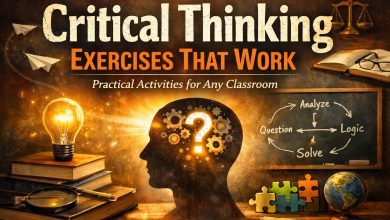
For classes that need stronger reasoning practice, you can adapt activities from these classroom critical-thinking exercises. Shorten the tasks and attach them to the lesson students have just completed.
Final Verdict
The best early finisher activities are short extensions of real learning, not rewards for speed and not piles of extra worksheets. Use a three-level routine, teach students to check their work, and keep a small menu of choices that build explanation, practice, reading, or creativity. That system gives students independence while protecting the teacher’s time and attention.
Frequently Asked Questions
Students should reread the directions, check their work, correct errors, and confirm they can explain their answer.
A practical system has three levels: finish and check, extend the thinking, and read, practice, or prepare.
Most activities should take between five and 20 minutes and include a clear stopping point.
Most early finisher work should not be graded because its purpose is practice, thinking, and independence.
Teachers can emphasize careful work, use specific quality checks, and approve extensions only after reviewing completed assignments.